AI Legal Intake for Law Firms. 24/7. No Missed Calls.
Last Tuesday, a $150K PI case called at 11:47pm. One law firm's AI intake answered. The other went to voicemail. Guess which one signed the client. ClaireAI picks up every call—nights, weekends, holidays.
How AI Legal Intake Captures Cases Your Voicemail Loses
We did the math: average PI case value times voicemail abandonment rate equals $8,000+ lost per missed call. Here's how automated legal intake changes that.
3am Christmas. We're working.
Your secretary isn't. Neither is your answering service—they charge double for holidays. We don't charge extra. We don't sleep. That DUI arrest at 2:47am on Thanksgiving? Picked up in 0.6 seconds.
We ask the questions your staff forgets.
Statute date? Checked. Prior representation? Asked. Minimum coverage requirements? Verified. One firm told us their intake people forgot the insurance question 40% of the time. We ask it 100% of the time. Every call. No exceptions.
They hang up with an appointment. Not a "maybe."
"We'll call you back" loses 67% of leads. We don't say that. We check your calendar, find the next slot, and book it. Done. Before they can call the firm whose billboard they passed five minutes ago.
We catch conflicts before you waste a consult.
Opposing party's name? We check it against your client list in real-time. Wrong jurisdiction? Flagged immediately. That awkward call where you realize you're already representing the other side? Doesn't happen anymore.
Why Leading Firms Switch to ClaireAI
Quantifiable performance differences between autonomous AI infrastructure and traditional human-based answering services.
| Performance Metric | ClaireAI (Autonomous) | Traditional Service |
|---|---|---|
| Avg. Response Time (Ring to Answer) | < 0.2 Seconds | ~45 Seconds (Variable) |
| Call Capacity (Concurrency) | Infinite (Unlimited) | 1 Call per Receptionist |
| Monthly Cost (Baseline) | $650 Flat Rate | $2.50 - $4.00 / minute |
| After-Hours / Weekend Coverage | Included (24/7/365) | Extra Fees / Shift Diff |
| Bilingual (English/Spanish) | Native Fluency (Included) | Often Unavailable / Premium |
| CRM Data Sync Speed | Instant (< 100ms) | Delayed (Manual Entry) |
Data Source: 2025 Legal Intake Benchmark Report & ClaireAI Platform Metrics
Why Leading Firms Switch to ClaireAI
Quantifiable performance differences between autonomous AI infrastructure and traditional human-based answering services.
| Performance Metric | ClaireAI (Autonomous) | Traditional Service |
|---|---|---|
| Avg. Response Time (Ring to Answer) | < 0.2 Seconds | ~45 Seconds (Variable) |
| Call Capacity (Concurrency) | Infinite (Unlimited) | 1 Call per Receptionist |
| Monthly Cost (Baseline) | $650 Flat Rate | $2.50 - $4.00 / minute |
| After-Hours / Weekend Coverage | Included (24/7/365) | Extra Fees / Shift Diff |
| Bilingual (English/Spanish) | Native Fluency (Included) | Often Unavailable / Premium |
| CRM Data Sync Speed | Instant (< 100ms) | Delayed (Manual Entry) |
Figure 1.1: Comparative Performance Analysis
Source: ClaireAI Platform Metrics (2025) & Legal Intake Benchmark Data (n=512 Firms)
Numbers don't lie. Neither do we.
Last 90 days across all clients
Average increase vs. voicemail
Faster than any human
Friday 6pm happens every single week. Are you ready?
-
78% of your leads call after 5pm
That's the actual number. We pulled it from 50,000 intake calls. Almost 8 in 10 people calling about legal problems do it outside business hours. If nobody answers, they don't leave a voicemail—they Google the next firm.
-
DUI at 2am gets different questions than a custody call
We built different intake flows for PI, criminal, family, immigration—14 practice areas total. The questions change. The urgency flags change. Because "when were you arrested" matters for criminal defense. "When did the accident happen" matters for PI. We know the difference.
-
"¿Habla español?" Yes. Fluently.
42% of PI leads in Texas, Florida, and California prefer Spanish. If your intake can't handle that conversation smoothly, you're losing cases to the firm that can. We switch languages mid-call if the caller prefers. No menu trees. No awkward transfers.
-
That TV spot you ran? Now you know if it worked.
Every call tagged by source. Every lead scored by value. So when you spend $15,000 on a billboard and get 47 calls but only 3 retainers—you'll know. And you can stop wasting money on what doesn't convert.
Monday you sign up. Next Monday you're live.
-
Day 1-2: We plug into your CRM
Clio? 15 minutes. Filevine? 20. Salesforce? 30 max. We've done this 200+ times. Your lead fields map to ours. When calls come in, data flows out—directly into your existing system. Nothing changes on your end except you stop missing leads.
-
Day 3-5: We build your intake scripts
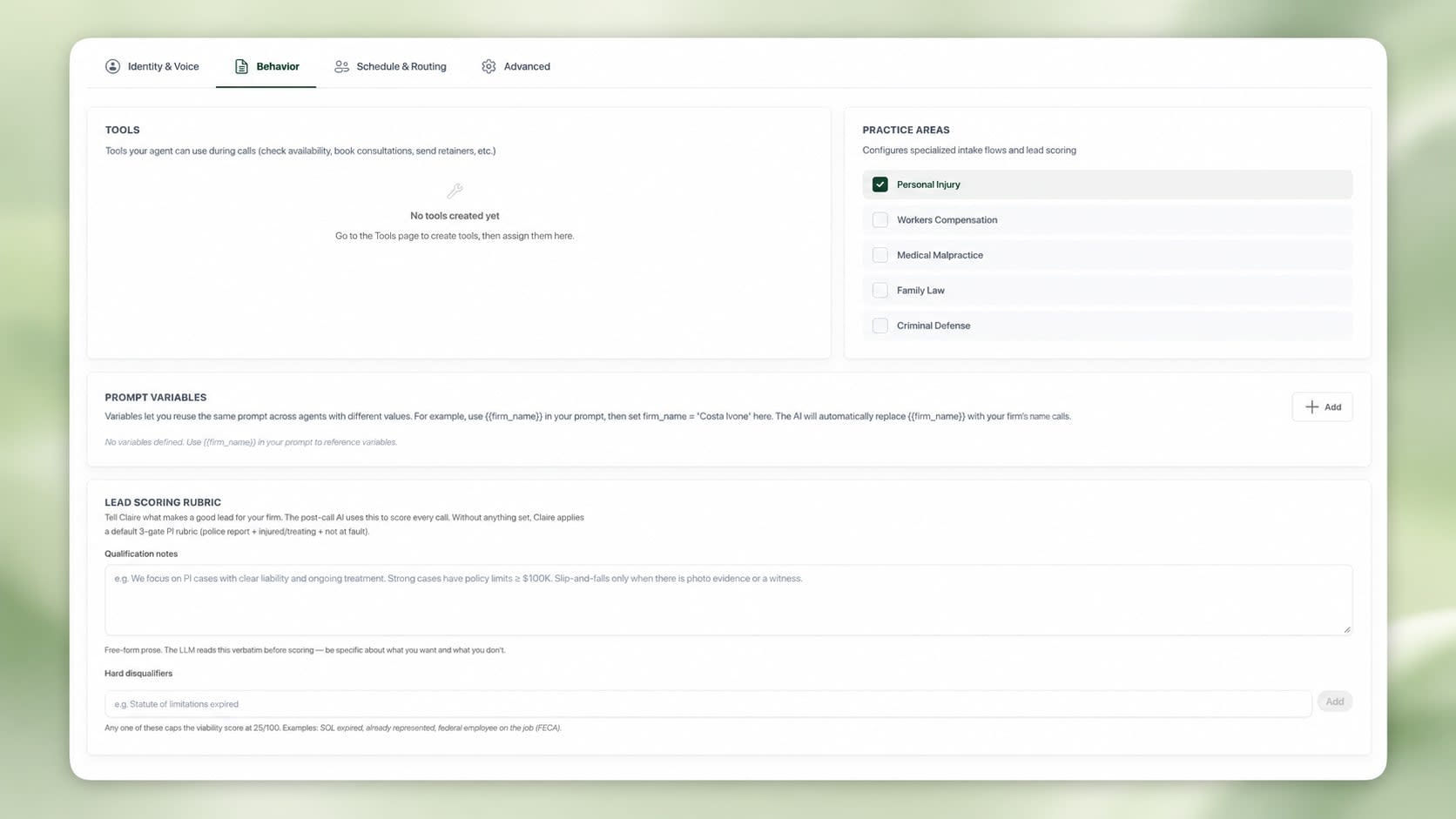
What do you actually need to know before taking a case? Statute date, minimum injuries, insurance minimums—whatever your criteria, we configure it. Personal injury firm in Florida has different questions than a criminal defense shop in Houston. We've built scripts for both. And 40+ other combinations.
-
Day 6-7: You call. We answer. Done.
We run test calls with your team. You hear how we handle a Spanish-speaking caller at 2am. You see the lead appear in Clio 8 seconds later. If anything sounds off, we fix it same-day. Then we flip the switch and you never miss another call.
-
Week 3+: We find more money
Your success manager reviews transcripts weekly. That billboard generating 50 calls but 2 retainers? We flag it. The intake question that's losing people? We fix it. This isn't set-and-forget. It's continuous optimization.
Every field filled. Every time. No chasing clients for details.
Your attorneys get complete intake packets, not Post-it notes
Stat date? We never forget to ask.
When did it happen? Is it within statute? What's the insurance minimum? We ask. Every call. Your intake people forget these questions 30% of the time (we measured). We don't.
Police report number, at-fault party, medical providers—captured.
Not "call them back Monday for the details." Captured in the first call. Conversationally, not like an interrogation. By the time your attorney opens the file, everything's there.
Conflict check runs before anyone sees the case.
Opposing party name gets checked against your client database in real-time. Wrong jurisdiction? Flagged immediately. You don't waste a consult on someone you can't represent.
$47,000 in new cases. First month.
"I was skeptical. Another AI thing, right? But then I looked at the numbers. First week: 11pm call, $85K motorcycle accident case. Would've gone to voicemail before. Third week: Saturday morning, Spanish-speaking client, rear-end collision. $32K settlement. That one call paid for six months of the service."
Your malpractice carrier will love this part.
We handle confidential intake conversations. That means security isn't optional—it's the whole point. Here's what we've built.
Claire doesn't make things up.
She only says what you've told her to say. No hallucinated legal advice. No improvised promises. Just the script you approved—every single time.
Your client calls don't train our AI.
Ever. Period. Your data stays in your isolated environment. We don't learn from your calls. We don't share anything with other firms. Complete separation.
SOC 2 Type II. Audited. Annually.
Not "we're working toward compliance." Done. Passed. BAA available for HIPAA coverage. Your IT person can verify. Your insurance company can too.
Claire knows she's not a lawyer.
She doesn't give legal advice. She doesn't make representations about case outcomes. She takes messages, qualifies leads, books consultations. Nothing more. Nothing that creates ethics issues.
Explore ClaireAI features
Discover how our AI-powered tools transform legal operations
What Does a Legal Intake Specialist Do?
A legal intake specialist is the first point of contact for potential clients—and often the most important touchpoint in your entire client acquisition process. They screen callers to determine if there's a viable case, collect essential details like incident dates and injury descriptions, identify which practice area fits, and check for conflicts of interest before sensitive information is shared. A good intake specialist also schedules consultations and sets expectations about next steps.
ClaireAI's AI performs these same functions 24/7 without hold times or human error. Every call gets answered on the first ring. Every question gets asked consistently. And every lead gets captured in your CRM immediately—not when someone remembers to enter it Monday morning.
The difference shows up in your conversion rates. Firms with dedicated intake specialists (human or AI) convert 30-40% more leads than those relying on whoever happens to answer the phone.
AI-Powered Intake Service for Law Firms
Traditional intake services for law firms bill by the minute or by the call—and that cost model creates problems. You hesitate to advertise aggressively because more calls mean higher bills. You worry about chatty callers running up the tab. And you never quite know what the monthly invoice will look like. AI legal intake changes this completely with flat-rate pricing that lets you answer unlimited calls without watching the meter.
But the real advantage isn't just cost—it's consistency. An AI law firm intake service delivers the same quality at 2 AM as at 2 PM. No training new staff when someone quits. No coverage gaps during lunch or sick days. And because the AI integrates directly with legal CRMs like Clio and Filevine, intake data flows automatically into your case management system without manual entry or transcription errors.
Leading legal intake tools now handle complex scenarios that seemed impossible just two years ago—multilingual conversations, detailed case qualification, even real-time conflict checking against your existing client database.
What Is Legal Intake and Why It Matters
Legal intake is the system your firm uses to capture, qualify, and route potential client inquiries. It sounds simple, but most firms don't have a formal process—calls go to whoever picks up, information gets scribbled on Post-its, and leads fall through the cracks. Firms without structured intake lose 30-50% of potential cases to slow follow-up or missed calls.
Good intake does three things: it captures every lead (no missed calls, no lost voicemails), qualifies them efficiently (so attorneys spend time on viable cases), and routes urgent matters appropriately (that DUI arrest can't wait until tomorrow). The best firms treat intake as a competitive advantage, not an administrative afterthought.
ClaireAI brings enterprise-grade intake to firms of any size. You get the same systematic lead capture and qualification that AmLaw 100 firms use—without hiring a dedicated intake team or paying call center rates.
Best Practices for Law Firm Intake Processes
After analyzing intake workflows at 200+ law firms, patterns emerge. The highest-converting practices share these traits:
Answer within three rings. Every ring after that drops conversion by 7%. Sounds small until you multiply it across hundreds of calls monthly. AI answers instantly—humans can't match that consistency.
Ask qualifying questions early. Don't spend 15 minutes on a caller who needs an attorney in a different state or practice area. Screen for jurisdiction, case type, and statute of limitations within the first minute. Then dive deeper only on viable leads.
Check conflicts before collecting sensitive details. This one trips up a lot of firms. You need to run conflict checks early in the conversation—not after the caller has described their entire case and you realize opposing counsel is already your client.
Route urgent matters immediately. A DUI arrest at 2 AM can't wait for business hours. Criminal matters, restraining orders, emergency custody issues—these need real-time attorney notification, not a voicemail that sits until Monday.
Follow up within 5 minutes on hot leads. The firm that calls back first signs 78% of clients. Speed kills in legal intake—every minute of delay gives your competitors an opening.
Client Intake Questionnaire: What to Ask and Why
Your intake questionnaire should capture everything needed to evaluate case viability without making callers feel interrogated. The balance matters. Here's what top-performing firms ask:
Contact basics: Name, phone, email, best time to call back. Simple, but 23% of firms somehow still lose this information between the call and the CRM entry.
Case-type-specific questions: For PI, you need incident date, location, injuries sustained, medical treatment status, insurance information. For criminal, you need arrest date, charges, court date, custody status. For family law, you need marriage date, children, separation status, pending motions. Generic questionnaires don't work—each practice area has different qualifying criteria.
Conflict check information: Opposing party names, addresses, any related parties. Run these against your existing client database immediately—before collecting confidential case details.
Urgency indicators: Court dates, filing deadlines, statute of limitations. These determine whether the lead needs immediate attorney attention or can wait for standard follow-up.
ClaireAI builds practice-area-specific intake questionnaires into its conversation flow. The AI knows what to ask a car accident victim versus someone facing DUI charges versus a parent seeking custody modification—and adapts the questions dynamically based on caller responses.
Common questions about legal intake automation
ClaireAI answers incoming calls and conducts structured intake interviews using conversational AI. During the call, it captures client contact information, case details, incident dates, and other relevant data. As soon as the call ends, ClaireAI automatically creates a new contact and matter in your practice management system, attaches the call transcript, and assigns a lead score based on case type and urgency. Your team sees qualified leads appear in real-time, ready for follow-up.
Yes. ClaireAI has native integrations with Clio Manage, Clio Grow, and Filevine. The integration creates new contacts, matters, tasks, and notes automatically. You can customize which fields get populated and how data is organized. ClaireAI also integrates with Salesforce, HubSpot, and any system that supports Zapier webhooks. Setup typically takes less than 30 minutes.
ClaireAI captures caller name, phone number, email, case type, incident details, injury information, opposing party names, insurance information, and any custom fields you configure. For personal injury cases, it asks about date of incident, medical treatment, and property damage. For criminal defense, it captures arrest details, charges, and court dates. All data is validated during the call and formatted for your CRM automatically.
Security is foundational to ClaireAI. We're SOC 2 Type II certified, HIPAA compliant with BAA available, and use 256-bit encryption for all data. Critically, client conversations are never used to train our AI models—your data stays completely isolated.
Plans start at $650/month for smaller firms (150 calls), with Growth at $1,250/month (500 calls) and Enterprise at $2,999/month (unlimited). Every plan includes 24/7 coverage, bilingual support, CRM integration, and full analytics. Compare that to $4,500+/month for a full-time receptionist who only works 40 hours a week.